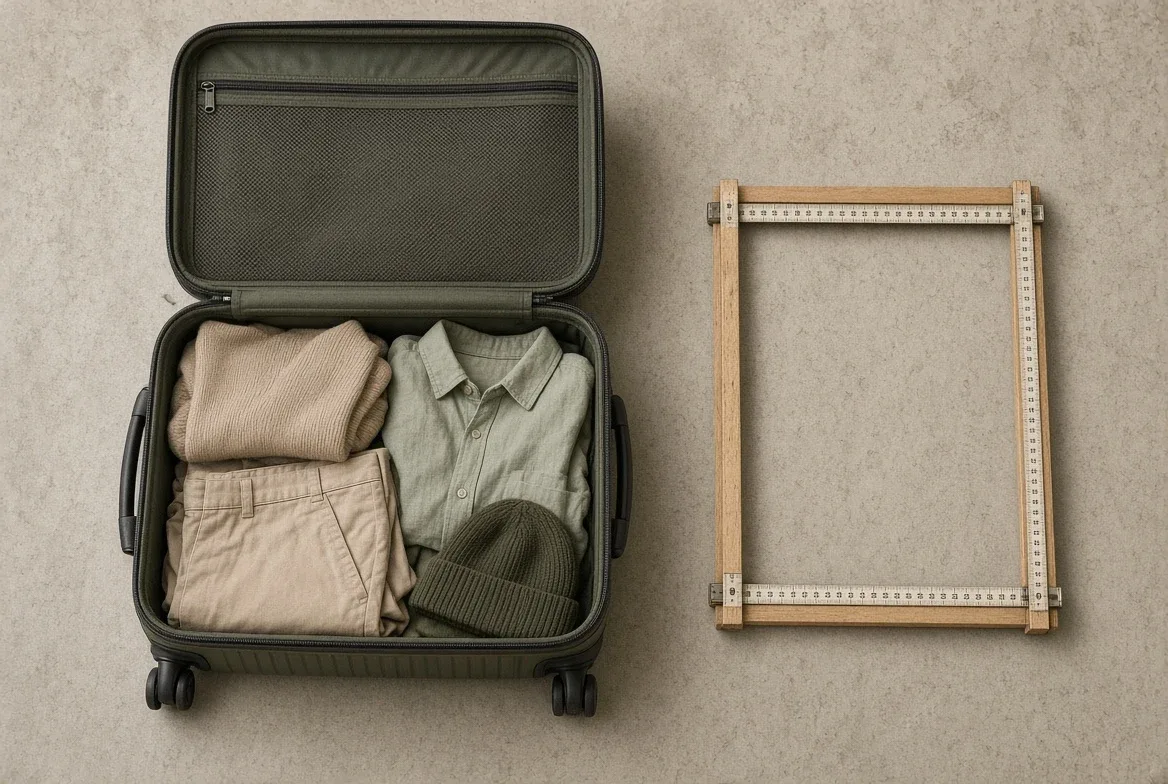
Buy to 22 x 14 x 9 inches, wheels and handles included — that's the carry-on limit Delta publishes for its own flights as of August 2026, and it's close enough to the industry default that a bag built to it clears most full-service US airlines without a second check. The catch: a handful of budget and international carriers still run smaller sizers, so that number is a floor to shop from, not a guarantee.
The reason to anchor on a single figure instead of memorizing each airline's chart is that most of the majors already converged on it. Delta's carry-on policy caps a bag at 45 linear inches combined — length plus width plus height — with no single dimension over 22 x 14 x 9 inches, a rule that includes any wheels or handles sticking out past the shell.
The number that covers the most airlines
According to a guide from AFAR, most major US airlines — United, American, Alaska and JetBlue alongside Delta — enforce that same 45 linear-inch standard, which is why it works as a shopping baseline rather than an airline-specific rule. Two US carriers are actually more generous: Southwest and Spirit allow up to 50 linear inches, and Allegiant permits 48, per the same guide. So a bag sized to Delta's limit will also pass those sizers with room to spare — it's the tighter carriers that are the real test.
Where the rules get tighter
International carriers spread out further. AFAR's roundup puts the range from easyJet's 39.6 linear inches — noticeably stricter than the US standard — up to British Airways' 50 linear inches. A bag built to the 45-inch US baseline can still fail an easyJet-style sizer, so anyone connecting through a budget European carrier should measure against that airline's own chart before departure rather than assume the US number travels with them.
Weight is the other place US and international rules diverge. Most US airlines don't weigh carry-ons at all, but AFAR notes two exceptions — Frontier caps carry-ons at 35 pounds and Hawaiian at 25 pounds — while international carriers impose weight limits far more often, ranging from Air China's 11-pound allowance up to British Airways' 51 pounds in the same report. A bag that's the right size can still get pulled at the gate if it's packed heavy on one of these routes.
Ultra-low-cost US carriers add a second squeeze: the personal item, not the carry-on, is where they get strict. The Points Guy points out that Spirit and Frontier's personal-item dimensions are tighter than most airlines' carry-on limits, citing an 18 x 14 x 8-inch bag as the kind of size that clears their under-seat requirement — smaller than the 22 x 14 x 9 that works as a full carry-on elsewhere.
What to check before you buy
A few habits from the same reporting keep a bag from getting gate-checked or fee'd, regardless of what it measures on the shelf tag:
- Measure with the wheels and handles on. Delta's policy explicitly counts protruding hardware toward the 22 x 14 x 9 limit, and other airlines apply the same logic — a bag that's compliant with its handle retracted can still fail the sizer with it extended.
- Check your fare class, not just your airline. The Points Guy flags that basic economy tickets on several carriers only include a personal item, no separate carry-on, so the bag that's fine on a standard fare can still get checked at the gate on a discount one.
- Confirm the personal item fits under the seat in front of you. That's the practical test airlines use at the gate, and it's stricter than any tape measure — a bag that's technically within the stated dimensions can still be too rigid or too full to slide under a narrower economy seat.
- Re-check the specific airline before flying internationally or on a budget carrier. Given how far outliers like easyJet and Air China sit from the US baseline, the safest move is confirming the operating carrier's current chart rather than assuming a bag that's cleared US sizers all year will clear a connecting flight too.
The short version
Size a bag to 22 x 14 x 9 inches / 45 linear inches and it will clear Delta, United, American, Alaska and JetBlue, and it'll have slack on Southwest, Spirit and Allegiant's carry-on sizers too. It won't automatically clear easyJet's tighter international limit, Frontier or Spirit's smaller personal-item slot, or a heavy pack on a carrier that weighs carry-ons — for those, the airline's own published chart is still the last word before you fly.
For a related travel news perspective, read How to count your Schengen days now that the border counts them for you.
For more context, read What Was the Comics Code Authority, and Why Did It End?.
For more context, read gambling.