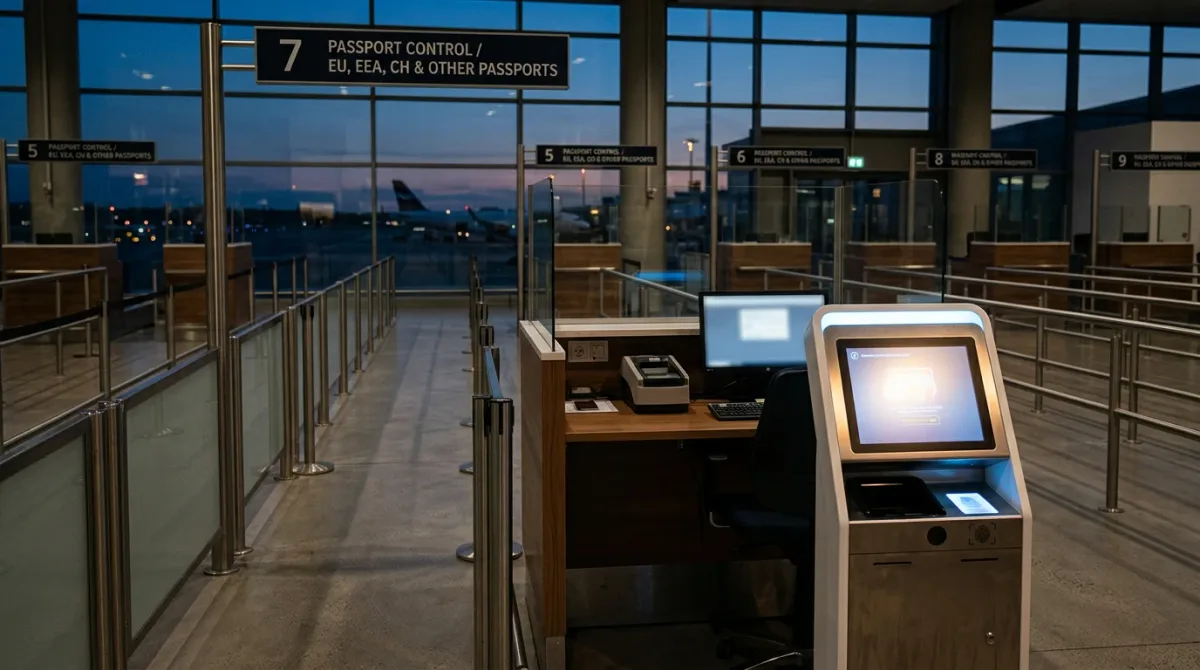
The European Union's Entry/Exit System became fully operational at every Schengen-area border checkpoint on April 10, 2026, ending more than six decades of ink passport stamps and replacing them with a fingerprint and facial-image registry for travelers from outside the bloc, according to the European Commission.
The system, known as EES, began a gradual rollout on October 12, 2025, so that individual border crossing points could bring the new hardware online in stages rather than all at once. For a first-time traveler, that means a passport scan, a facial photograph, and in most cases fingerprints, taken either by a border officer or at a self-service kiosk. Travelers who have already registered and hold a biometric passport can use the kiosks again on later trips, provided they crossed within the past three years; the system checks identity rather than re-collecting biometrics. EU and EFTA citizens, and a handful of other groups including long-stay visa and residence-permit holders, are exempt.
What the change produces, beyond a faster line, is a searchable record, and the bloc's border-technology agency, eu-LISA, has begun publishing what that record shows. Its first quarterly report, covering January through March 2026, tallied 19,985 refusals of entry across Schengen borders, 11,885 extensions of stay, and 665 revoked stay authorizations, according to eu-LISA's quarterly report. Ukrainian nationals accounted for the most refusals, 4,771, followed by Albanian and Moldovan travelers. The most common reason cited was insufficient proof of the purpose or conditions of the visit, followed by travelers found to have already exceeded a previous stay. Extensions skewed the other direction: American travelers received more approved extensions, 6,565, than any other nationality, ahead of Canadians and Japanese travelers.
eu-LISA, the agency that operates the EES database, cautioned that the quarter's figures are incomplete, since not every border point was fully wired into the system during the reporting window, and that it is withholding overstayer statistics until deployment is complete across all crossing points. A fuller picture, officials indicated, will come with the next quarterly release.
For travelers, the practical shift is procedural rather than visible on a stamped page: there is no more ink to check for a departure date, and the three-year window before a kiosk asks for fresh biometrics again is the closest thing to a renewal date the new system carries.
For a related slow travel perspective, read What it takes to walk the Camino Francés.
For more context, read Do You Need a Visa for the UK? The ETA Rules, Dated.
For more context, read crowdstrike.
For more context, read UK film tax claims are not back to pre pandemic levels.