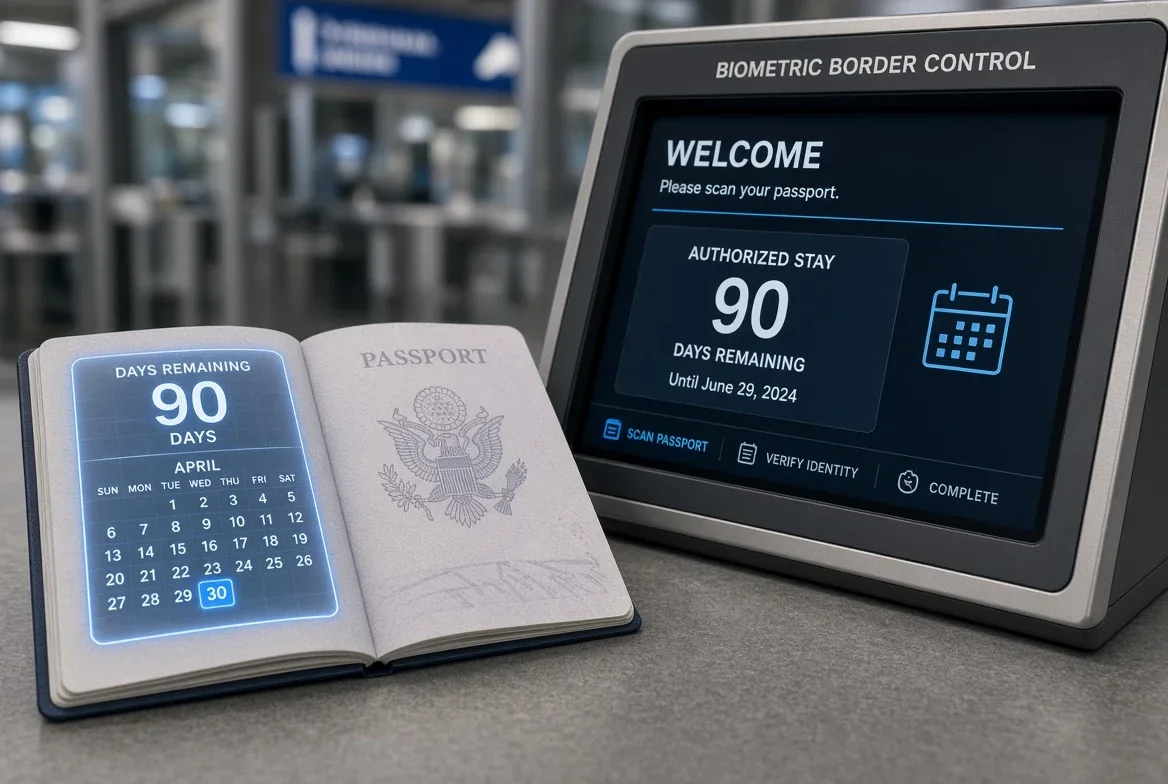
If you're trying to work out how many days you have left in Europe, stop counting on your fingers and open the European Commission's own short-stay calculator. Since 10 April 2026 the EU's Entry/Exit System has been doing the counting for you at the border, and it does not round in your favour.
The rule, in the only form that matters
You get 90 days in any 180-day period. Not 90 days a year, not 90 days per country — 90 days inside a window that slides along behind you. The Commission's short-stay calculator states the method plainly: count back 180 days from each day of your stay and make sure the total does not exceed 90. The U.S. State Department puts the same limit in traveller terms — with a valid U.S. passport you can stay up to 90 days during any 180-day period, and once you've used them you wait an extra 90 days before applying to re-enter.
The area this applies to is 29 countries: 25 EU member states plus Iceland, Norway, Switzerland and Liechtenstein, according to the Commission. Hopping from France to Spain to Portugal doesn't reset anything. It's one pot.
The calculator runs in two modes, per the Commission: a check mode that tells you whether your past and current stays are compliant as of the day you check, and a planning mode that tells you the maximum stay allowed on a future date. Use planning mode before you book, not after. One exclusion worth knowing: the Commission says time spent on an EU residence permit or a long-stay D-type visa should not be entered, because those holders aren't subject to the 90/180 rule at all.
What changed when the machine started counting
The honour system is over. The Commission's Entry/Exit System registers your name, travel document data, fingerprints and facial image, and the date and place of every entry and exit, and it replaced passport stamping on 10 April 2026 — the same page says the system enables automatic detection of overstayers. Progressive operations had started on 12 October 2025.
The scale is not theoretical. In its 10 April 2026 announcement that the system was fully operational, the Commission said more than 52 million entries and exits had been registered since the October start, with more than 27,000 refusals of entry. Time, reporting on 12 August 2026, put the running total at 160 million border crossings and more than 32,000 people refused entry as of mid-April.
Practically, that means the fuzzy stamp a border officer couldn't read is no longer your friend, and neither is the one they forgot to apply. If you've been quietly assuming a missing stamp bought you a week, assume the opposite now.
What if you're flying in during peak season?
Budget for the border, not just the flight. Time reported on 12 August 2026 that the airport trade body ACI Europe found queues at airports in 15 countries averaging two to three hours or longer during peak periods after full rollout, with waits reaching five hours at peak by July; the same report says Paris and Amsterdam temporarily suspended biometric collection and went back to manual processing to clear the backlog.
Who should plan around this: anyone with a tight onward connection, anyone travelling with small children or someone who can't stand in a queue for hours, and anyone whose first Schengen entry since the rollout is on this trip — that's the visit where your biometrics get captured, so it's the slow one. Who can relax a bit: travellers already registered on a previous trip, since the enrolment step is the expensive part.
One thing that isn't negotiable. Time reports that travellers who refuse to provide biometric data will be denied entry. There is no opt-out lane.
Does your passport still work for this?
Two separate checks, and people conflate them. First, validity: the State Department says your passport must be valid for at least three months beyond your planned departure from the EU — so it's your exit date plus three months, not your entry date.
Second, whether it's biometric. AFAR, in a piece updated 26 March 2026, notes that travellers without biometric passports face additional screening and can't use the self-service kiosks. If yours is an older non-biometric book, skip the kiosk queue entirely and go straight to a staffed desk — you'll be sent there anyway.
And ETIAS — do you need it yet?
Not as of the State Department's current guidance for U.S. travellers in Europe, which says U.S. citizens do not need an electronic travel authorisation and that ETIAS is planned to launch in late 2026. AFAR's March 2026 update describes a €7 non-refundable application fee, with travellers under 18 and over 70 exempt from the fee but still needing approval, and says the EU will announce the specific start date closer to the requirement. Treat any site charging you for ETIAS today as a site charging you for nothing.
Who this actually bites
If you take one two-week holiday a year, none of this constrains you; the only thing that changes is how long you stand at the border. The 90/180 arithmetic is a real problem for a narrower group: people doing a long slow summer across several countries, remote workers stretching a stay, and anyone with a pattern of repeat short trips that quietly stack up inside the same 180-day window.
If that's you, the move is boring and effective. Log every entry and exit date as it happens, run the Commission's calculator before each new booking rather than after, and keep boarding passes for anything a database might have recorded oddly. The system now has a permanent record of your movements. The cheapest insurance is having the same record yourself.
For a related reviews perspective, read How to pick a carry-on bag that clears every airline's sizer.
For more context, read The Visa Extraordinary: A Pathway for Exceptional Talents.