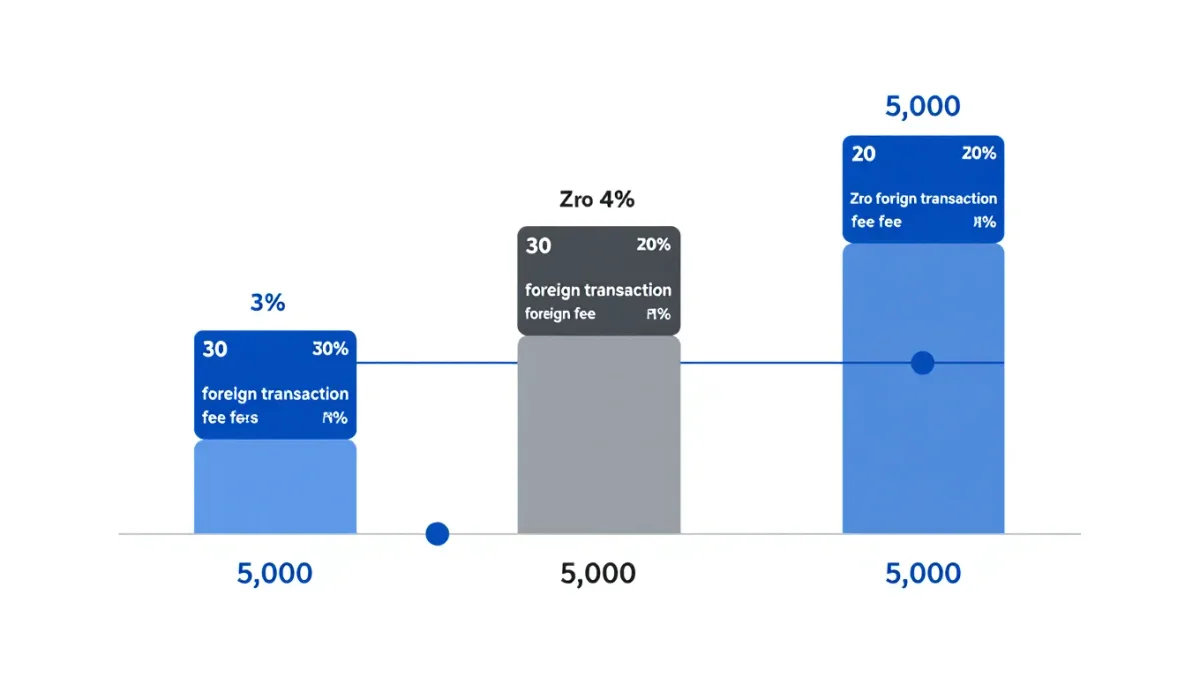
Choose a travel card by working down four questions in order: does it charge a foreign transaction fee, will the network be accepted where you're going, does it include the insurance you actually use, and does the annual fee survive the math? On the first question, the stakes are concrete: a standard 3% foreign transaction fee costs about $150 on $5,000 of overseas spending, and the US Consumer Financial Protection Bureau's materials describe these fees as typical on cards that lack the feature — so a no-foreign-fee card is the baseline, not the luxury.
Fees and terms change; verify any card's current terms in its disclosure before applying.
What does the fee math look like?
| Card type | FX fee | Cost on $5,000 abroad |
|---|---|---|
| Standard card | ~3% | ~$150 |
| No-foreign-fee card, no annual fee | 0% | $0 |
| No-fee card with $95 annual fee | 0% | $95 — wins only above ~$3,200 spend vs a fee card with rewards |
The annual-fee decision is a breakeven calculation, not a preference: a $95 fee needs roughly $3,200 to $4,000 of annual foreign spending before the extras (points multipliers, credits, insurance) pay for it, depending on how you value rewards. Spend less abroad, and a fee-free no-FX card wins. The comparison basis matters — rewards valued at a claimed point value is where card marketing and reality diverge most.
Does acceptance matter more than rewards?
Yes, especially outside North America and parts of East Asia. Visa and Mastercard have the broadest global merchant acceptance; American Express works well in the US and at major international chains but fails at small restaurants, markets, and rural businesses elsewhere. The two-card strategy is the practical answer: a primary no-FX card on a broadly accepted network, plus a backup from a different network in a different bag. Cash still matters at street markets and small transit vendors in much of the world, so the card strategy is really a card-plus-cash strategy — the card for hotels, restaurants, and tickets; a modest ATM withdrawal from a low-fee account for everything else.
What do the insurance features actually cover?
- Rental car coverage: the most valuable included benefit, when it is primary collision coverage — paying the rental company directly without touching your own insurer. Many cards offer secondary coverage only; the difference is real money after a claim.
- Trip delay and cancellation: reimbursement thresholds vary widely — hours of delay covered, per-person caps, documentation rules — read before you rely on it.
- Lost luggage: a small fixed cap on most cards; useful, never sufficient alone.
- Medical: card travel-medical coverage is the weakest category and often excludes pre-existing conditions; this is the gap travel insurance fills, not the card.
Which spending traps cost more than the annual fee?
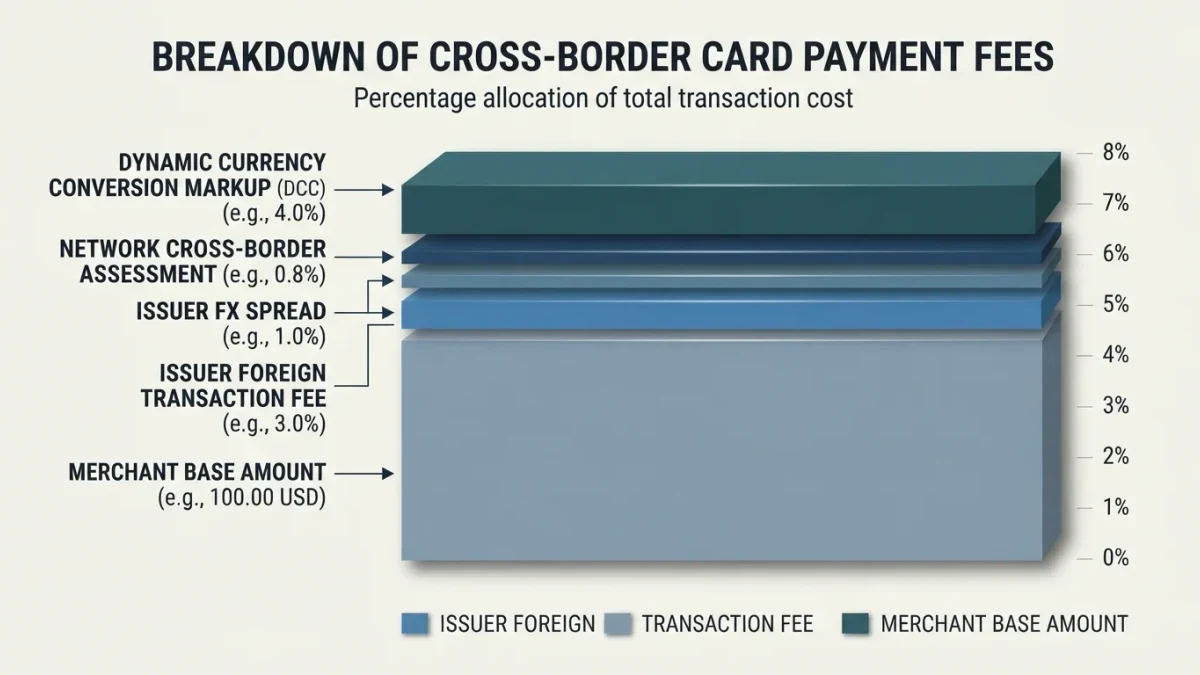
- Dynamic currency conversion: when a foreign terminal offers to charge you "in dollars," it is applying its own exchange margin, commonly 3-8% worse than your network's rate. Always choose to pay in the local currency.
- ATM cash advances on a credit card: fees plus immediate interest from day one — use a debit card designed for travel instead.
- Hotel and rental holds: card issuers place holds that can lock a card mid-trip; carrying two cards is the insurance that costs nothing.
- Not notifying travel of anything: modern fraud models need less notification than a decade ago, but a card that dies abroad because of an unexpected fraud hold is a known failure mode — the second card is the remedy, again.
How should couples and families structure cards?
Two people, four payment tools, two bags: each traveler carries one no-FX card and one backup from a different network, with the pair split so that a single theft cannot take all four. Where cards earn points, concentrating spending on one account concentrates redemption value too, but the household rule outranks optimization: no bag carries both travelers' primary cards. Families add a fifth tool — a small amount of local currency in cash per child's pocket, which converts the lost-card scenario from a family emergency into a minor delay while the replacement ships. And because card benefits extend to additional cardholders on many products, a free authorized-user card for a spouse or teen inherits the FX-free feature and often the rental coverage — one of the few genuinely free upgrades in the system.
Points, cashback, or nothing?
Points reward travelers who fly one airline family often enough to hit redemption sweet spots; cashback rewards everyone else with value that never devalues overnight. If your travel is occasional and multi-carrier, a no-annual-fee, no-FX cashback card is the honest answer; points programs justify their complexity at higher spending volumes and stable airline or hotel loyalties. Either way, the no-foreign-fee feature is the non-negotiable core — every other benefit is negotiable around it.
Fees described are typical industry figures as of early 2026, per consumer-protection materials — confirm current terms in the card's own disclosure before applying.