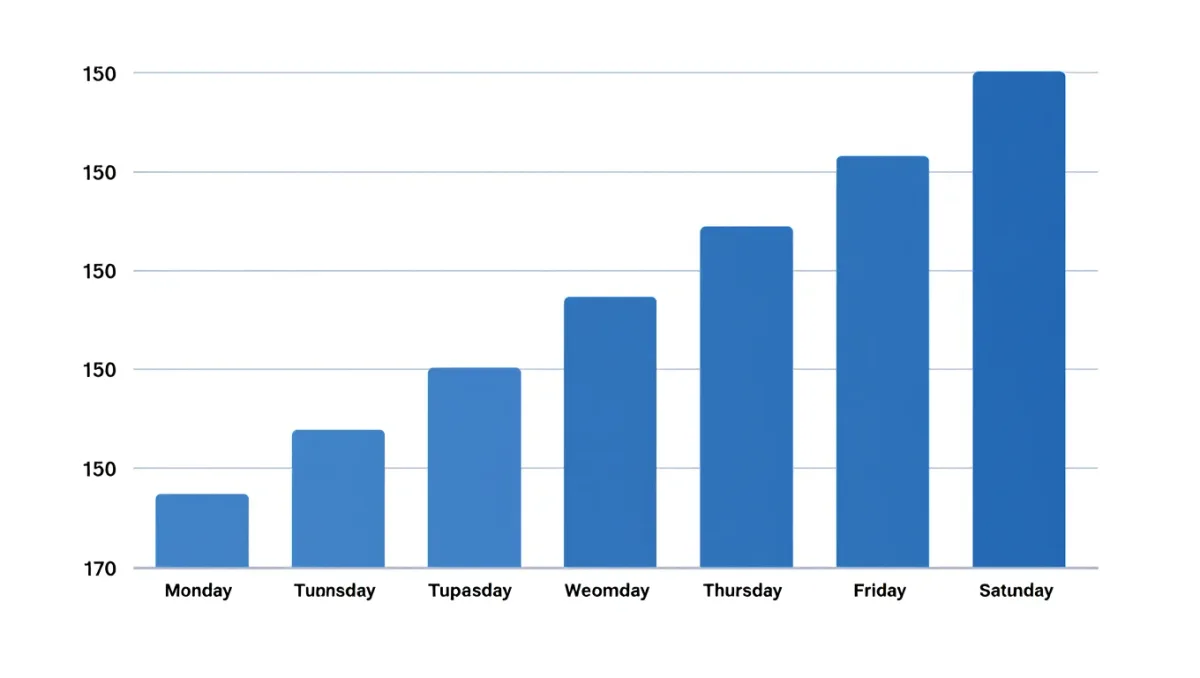
Fly on Tuesday or Wednesday and you usually pay less: Expedia's annual air travel report, built on ARC ticketing data, has repeatedly found that travelers who depart on a Thursday or Friday instead of a Sunday save roughly 10 to 20 percent, as of its 2025 edition, and Google Flights' price analysis points the same way — midweek departures carry lower average fares than weekend peaks. The reason is simple supply and demand: leisure travelers crowd Fridays and Sundays, so airlines file higher fares for them, while Tuesday and Wednesday cabins fly business travelers and price-sensitive flyers.
This is information, not booking advice — day-of-week averages shift by route and season, so always check your specific dates.
Which departure days are actually cheapest?
The pattern is consistent across the two largest public datasets. In Expedia's report with ARC, Thursday and Friday were identified as the most expensive departure days for US domestic travel, with savings of around 13 to 20 percent for departing earlier in the week; Google Flights' published insights show Wednesday often pricing lowest on domestic routes, with Saturday a close second in some markets. The absolute numbers move year to year, but the ranking — midweek low, weekend high — has held across every edition of both reports in recent years.
Does the return day matter too?
Yes, and it is often forgotten. A Tuesday-out, Wednesday-back or midweek-to-midweek itinerary hits the cheap end of the fare calendar twice. The classic cheap pattern for a week-long trip is departing early in the week and returning midweek — avoiding both the Sunday-evening leisure rush and the Friday business return. Saturday departures can also price well on leisure routes, since airlines compete for the week-long vacation crowd; on business-heavy routes, Saturdays are quiet and cheap for the same reason.
How much can shifting a day actually save?
Enough to restructure a trip around. On a $400 base fare, the 10 to 20 percent day-of-week spread reported by Expedia and ARC amounts to roughly $40 to $80 per person each way. For a family of four, moving the departure from Sunday to Tuesday can save hundreds of dollars — typically far more than the value of waiting an extra week to book. The flexible-date grid on any major search tool makes this visible in seconds: look at a seven-day view around your dates and pick the lowest bar, not the date you first assumed.
Is the day you book completely irrelevant?
It is much less important than the day you fly, but the data shows one small real effect: booking earlier in the week tends to be marginally cheaper than booking on weekends, when leisure search volume peaks. The difference is small — low single digits at most in published analyses — so treat it as a tiebreaker, not a strategy. The booking window remains the dominant factor on the purchase side.
When does the midweek rule break?
Three situations flip the pattern. First, peak-holiday periods: around Thanksgiving or Christmas, the cheapest departure may fall on the holiday itself — Christmas Day and Thanksgiving Day historically price far below the surrounding travel days — so the calendar logic inverts. Second, seasonal leisure routes: in deep low season, airlines discount weekends to fill seats and the weekday spread narrows to noise. Third, international routes: the US domestic day-of-week pattern does not map cleanly onto transatlantic or intra-Asia pricing, where seasonality dominates. Check the seven-day price view rather than assuming the rule travels.
Does time of day change the price?
Often, and it compounds with the day-of-week effect. Early-morning departures — the 6 a.m. to 8 a.m. bank — tend to price below midday flights, partly because leisure travelers avoid waking at five. Early flights also have a practical bonus documented in US DOT on-time statistics: delays accumulate through the day, so the first departures of the morning are reliably the most punctual. A Tuesday 6:30 a.m. flight is the fare calendar and the delay statistics agreeing with each other; the trade-off is an early alarm and, in some cities, limited public transit to the airport at that hour.
Red-eye flights price cheaply for the same discomfort reason. If you can sleep on a plane, overnight transcontinental and transatlantic departures are among the lowest fares in any given market — just build the next day around recovery.
How to use this when planning
- Pull up the flexible-date or seven-day price view before fixing your dates.
- Prefer Tuesday or Wednesday departures and midweek returns on domestic routes.
- Consider flying on the holiday itself for Christmas or Thanksgiving trips — the data favors it every year.
- Compare the total: a $60 saving that costs you an extra hotel night is not a saving.
The day-of-week figures above come from Expedia's ARC-based air travel report and Google Flights insights, checked as of early 2026; both datasets are refreshed annually, so verify the current edition before your next booking.