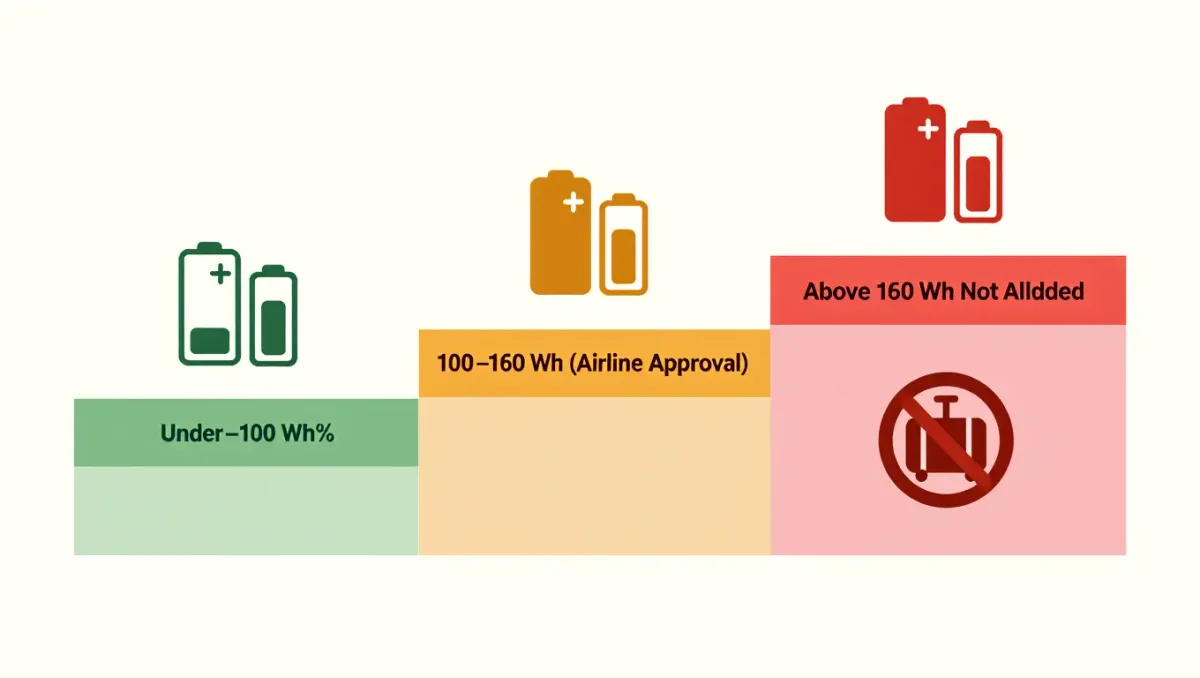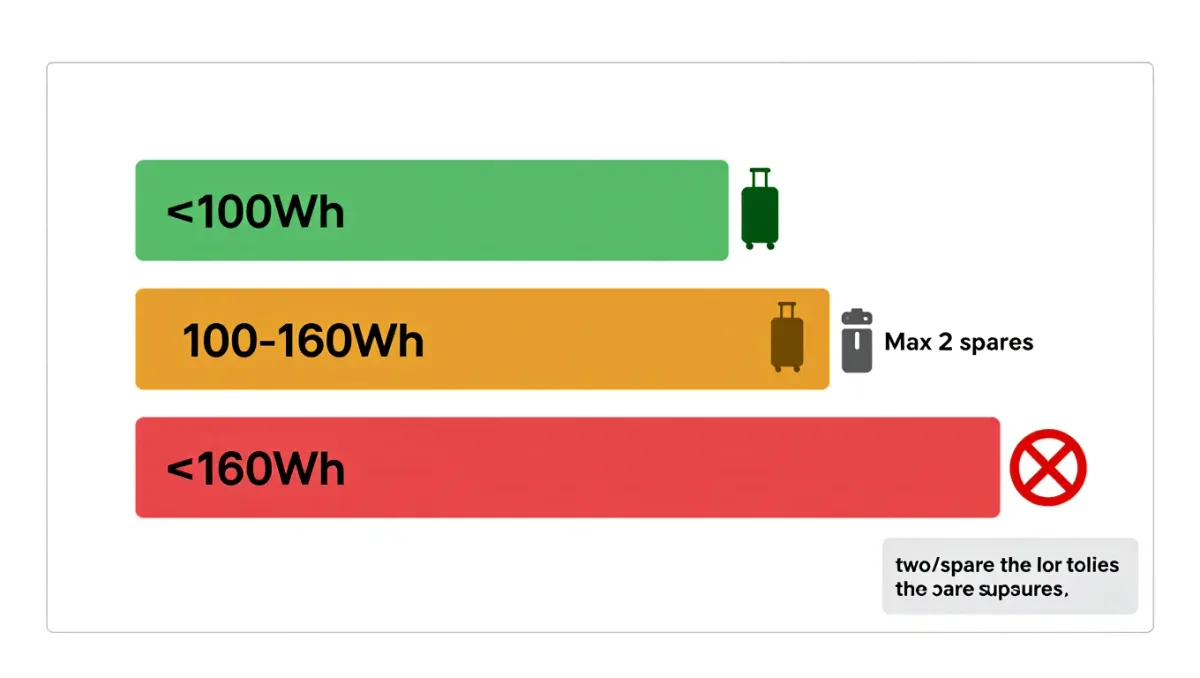
The rules for flying with batteries are three numbers, per the IATA framework airlines apply worldwide: spare lithium batteries and power banks travel in carry-on baggage only; anything up to 100 watt-hours needs no approval; batteries from 101 to 160 watt-hours need airline approval and are limited to two spares per passenger — and anything above 160Wh is cargo-only, off passenger flights entirely. The 2025 addition is about use, not carriage: after a series of onboard battery fires, a number of Asian carriers announced that power banks must be stowed and may not charge devices during the flight — a policy trend worth checking per airline before you fly.
Rules follow FAA and IATA guidance as of mid-2026; airline policies on inflight use vary — confirm with your carrier.
How do you calculate watt-hours from the label?
Multiply milliamp-hours by the battery voltage and divide by 1,000: Wh = mAh × V / 1,000, with lithium cells running at 3.7 volts. The arithmetic behind the limits:
| Capacity at 3.7V | Watt-hours | Flying with it |
|---|---|---|
| Up to 27,000 mAh | ≤100 Wh | Carry-on, no approval, spares protected from short circuit |
| 27,001-43,000 mAh | 101-160 Wh | Carry-on with airline approval, max two spares |
| Above 43,000 mAh | >160 Wh | Forbidden on passenger flights |
A 20,000 mAh power bank — the travel-standard size — is 74 Wh: comfortably legal everywhere, in the cabin. Where the label shows only mAh, do the math yourself; where it shows neither, the battery is treated as unapproved, which is one reason no-name packs are a problem at checkpoints.
Why the carry-on-only rule?
Lithium battery failures — thermal runaway — are survivable where a crew can see them and act: flight attendants train for battery fires with containment bags and water dousing, and a smoke event at a seat is a manageable emergency. The same event in a cargo hold, away from eyes and firefighting, is not, which is why spare lithium batteries were banned from checked baggage years ago and why installed batteries follow different rules than spares. The corollary travelers miss: a device with an installed battery — laptop in a suitcase, drone in a duffel — should be off and protected from accidental activation, and some carriers ask for installed-battery items in the cabin too when they are large.
What changed with the onboard-use bans?
Through 2025, a string of incidents — overheating packs, smoke in cabins, several emergency diversions — pushed carriers, notably a wave of Asian airlines, to prohibit using power banks during flight: charging the pack itself or charging devices from it. The packs still fly, stowed at the seat rather than in overhead bins on some carriers, so crew can spot trouble. The policy logic is simple: fires at seats get caught early. For travelers the practical answer is a two-part kit — a full charge before boarding for the devices that matter, and the assumption that seat power, where the aircraft has it, does the inflight charging. Policies are airline-specific and still evolving, so the carrier's own page — not last year's memory — is the source.
What about the devices themselves?
Installed batteries follow their own logic: a laptop, phone, or camera with an installed battery can travel in checked baggage only when fully powered off and protected from activation — but the better habit, and a hard requirement on many carriers for larger items, is cabin carriage. Laptops at security come out of bags for X-ray screening; smart bags with built-in batteries must have a removable pack, and if the pack cannot come out, many carriers refuse the bag entirely — a rule that has quietly killed the smart-bag category. Medical devices with lithium packs fly with documentation and the same cabin preference. The unifying read across all these rules: the more energy in the enclosure, the more the system wants it where a human can watch it, and the exceptions are narrow, documented, and granted at the gate rather than the booking page.
Which other battery rules catch travelers?
- Loose spares: spare batteries' terminals must be protected — tape over the contacts or each battery in its own bag — and they never travel in checked bags.
- E-cigarettes: devices with lithium batteries go in the cabin only, and vaping onboard is prohibited fleet-wide; charging them from seat USB is banned on most carriers.
- Drones and camera packs: typically 100Wh-class spares — count them against the two-spare allowance on the 101-160Wh tier.
- Damaged or recalled packs: a swollen, dropped, or recalled battery is prohibited outright, regardless of watt-hours — the damage, not the size, is the hazard.
- AA/AAA disposables: alkaline batteries are unrestricted; rechargeable NiMH cells ride as spares with terminals protected, but they are not the regulatory problem lithium is.
Thresholds per FAA/IATA guidance as of mid-2026; onboard-use policies changed repeatedly through 2025-2026 — check your specific airline within a week of flying.