One carry-on plus one personal item covers any climate on the calendar, if the kit is built as a layering system instead of a pile of outfits. The floor is smaller than most travelers guess: Air Canada caps a personal item at 13 by 17 by 6 inches, as of October 2026. Carriers differ on every dimension, so the sizes below act as ceilings to design against, never as starter suggestions.
The system earns its keep on real trips, not in the closet. Before any nonrefundable leg gets booked, choosing travel insurance you would actually use protects the money the bag cannot.
Everything here hangs on published carrier limits. More planning pieces sit in the Guides collection, including full walk-throughs for routes and budgets.
Which Bag Size Should Anchor the System?
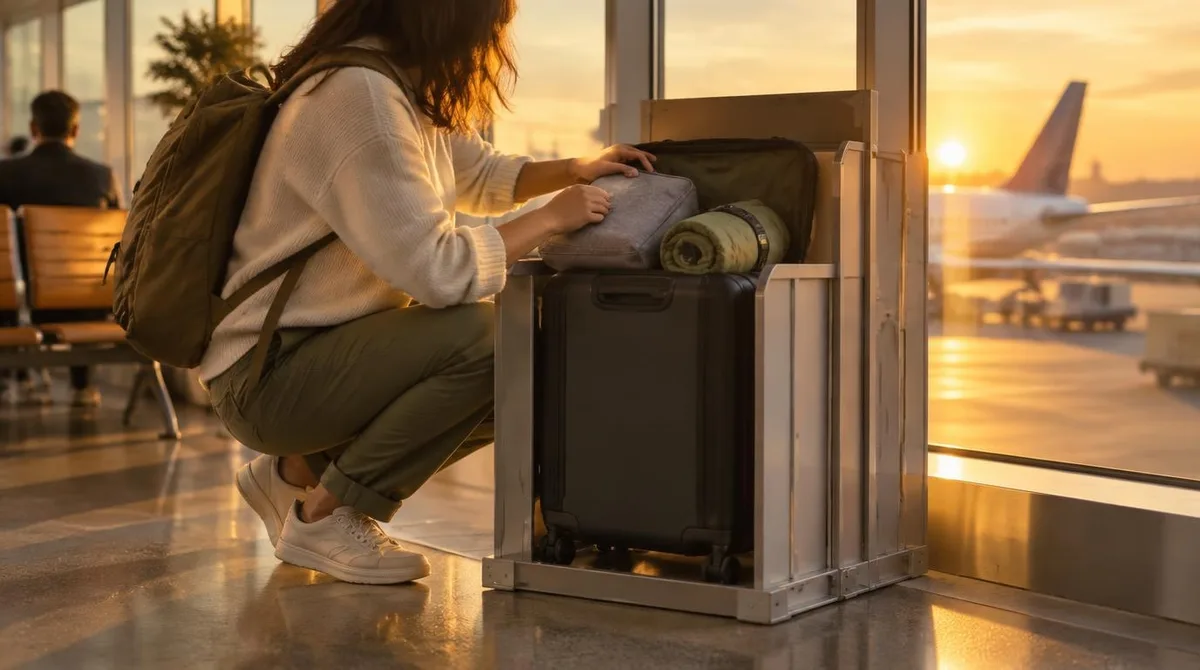
Learning how to pack light starts with the ceilings, not the wish list. Delta publishes 22 by 14 by 9 inches including wheels and handles, a 45-linear-inch total, as of March 2026, per its carry-on size page. Air Canada lists a standard item at 9 by 15.5 by 21.5 inches, with maximum dimensions counted including wheels and handles, as of October 2026, per its carry-on baggage policy. Buy to those numbers and nearly every bin accepts the bag.
What Goes in the Personal Item?
The under-seat bag is the survival kit: documents, medication, electronics, and one change of clothes, because checked scenarios start when bins run out. Delta treats the personal item as anything that fits under the seat in front of you, as of March 2026. Air Canada's 13 by 17 by 6 inch ceiling fits a slim daypack, as of October 2026, which doubles as the city bag on arrival. Readers following this should also see Power Banks and Lithium Batteries on Planes: The 100Wh Rule, the 160Wh Ceiling, and the New Onboard-Use Bans.
How Do You Build a Kit for Hot and Cold in One Bag?
Layers beat outfits. Pack two or three merino or quick-dry tops, one warm mid-layer, and one waterproof shell, then repeat colors so every piece pairs with the rest. In heat, the same quick-dry rotation plus a hat covers it. In cold, the shell and mid-layer ride onto the plane on your body, leaving the case free for the lightweight stuff. Fabrics do the heavy lifting here: wool resists odor, while cotton dries too slowly for a one-night sink wash. We covered a connected angle in How to Beat Jet Lag: What Actually Works, According to the Evidence.
What Carrier Rules Surprise New One-Bag Travelers?
- Step 1: Check the fare class, because Air Canada notes Economy Basic fares bought after January 3, 2025 allow only one personal item on some itineraries, as of October 2026.
- Step 2: Expect automated enforcement, since Air Canada runs carry-on sizers at pre-security or pre-boarding, as of October 2026.
- Step 3: Mind weight as well as size, because Air Canada sets no weight limit but requires the bag to stow in the bin without assistance, as of October 2026.
- Step 4: Assume oversized bags get checked, which is exactly how Air Canada phrases its policy, as of October 2026.
One aside for the skeptical: the sizer test at home takes two minutes and settles every argument about whether the bag is legal.
How Do You Keep the Kit Honest on Long Trips?
Laundry is the multiplier. Three days of clothing plus one sink-wash night per week stretches a single case across months, and quick-dry fabrics are ready by morning. Weigh the packed bag on a luggage scale, then do a one-week trial run before a long haul. Whatever came home untouched stays home next time, and the case shrinks a little on every trip.
Conclusion: Buy to the Ceiling and Pack in Layers
A one-bag system survives any climate through arithmetic, not heroics. Anchor the case to published carrier sizes, push bulk onto your body, rotate quick-dry layers, and keep the essentials riding under the seat. Do that, and the same small bag works for a heat wave in July and a cold snap in January.