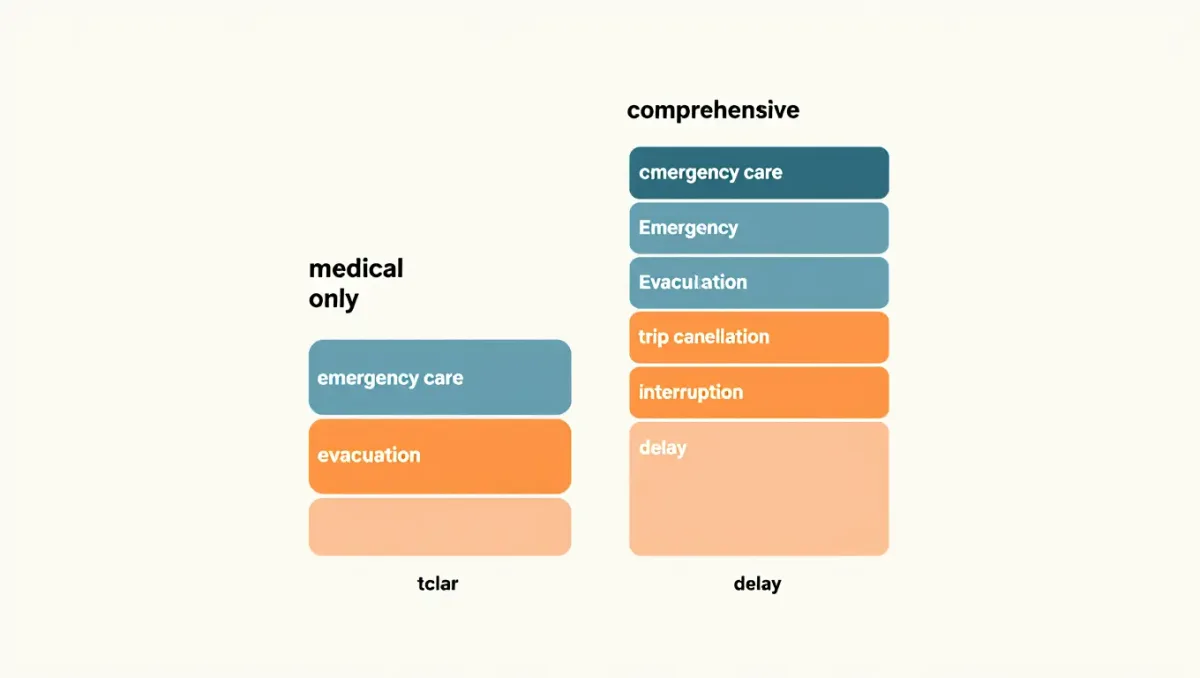
Travel insurance works by pooling four coverages into one policy — trip cancellation and interruption, emergency medical, medical evacuation, and baggage — priced at roughly 4 to 8 percent of your prepaid, nonrefundable trip cost, per published industry rate ranges as of 2025. The single most misunderstood part: standard trip-cancellation cover pays only for a policy's named perils — sudden illness, severe weather, the carrier's own failure — not for any reason you happen to have. Cancel-for-any-reason (CFAR) upgrade exists for that, and it costs substantially more while reimbursing only part of the trip cost.
This is information, not insurance or legal advice; policy wording controls everything, so read the actual certificate before you buy.
What does a standard policy actually cover?
Four buckets, in descending order of importance for most travelers. Trip cancellation refunds prepaid, nonrefundable costs if you must cancel for a covered reason: documented sudden illness or injury, death in the family, severe weather closing your destination, jury duty, or your carrier ceasing operation. Trip interruption pays the unused portion and sometimes the cost of getting home early, typically at 150 percent of the cancellation limit in standard plans. Emergency medical covers treatment abroad, where your domestic health plan often provides little or no payment. Medical evacuation — the least used and most expensive-per-case benefit — moves you to an adequate hospital or home, with serious cases costing six figures without cover.
What is not covered?
The exclusions list is where claims die. Pre-existing medical conditions are excluded by default unless you buy within a short window — commonly 14 to 21 days from the first trip payment — when a waiver applies. Changing your mind, a work conflict, or fear of traveling is not a named peril on standard plans. Epidemics and government travel bans fall into a gray zone that shifted after 2020: many policies now explicitly exclude known-event losses, meaning a documented outbreak that existed before you bought is not covered. High-risk activities — skiing off-piste, diving beyond your certification, motorcycling without a license — are typically excluded unless you add an adventure rider.
When is travel insurance worth buying?
The decision rule is financial exposure, not anxiety. Insure when the trip is expensive, prepaid, and nonrefundable; when you are traveling somewhere your health plan does not reach; or when a medical evacuation could be ruinous — cruises, remote regions, developing-country hospitals. For a cheap domestic trip on a refundable fare paid by a card with travel protections, a standalone policy usually adds little. Middle cases — a $3,000 international trip with a strict-cancellation hotel — are where the 4 to 8 percent premium earns its keep.
How much does it cost, and what is CFAR?
For a $5,000 trip, expect roughly $200 to $400 for a comprehensive standard policy in the 2025-2026 market. Cancel-for-any-reason adds roughly 40 to 50 percent to the premium and, even then, typically reimburses 50 to 75 percent of prepaid costs, per published plan comparisons — and it must usually be purchased within the same short window after your first trip payment. CFAR is for trips where your plans themselves are uncertain, not for general caution.
How do claims actually work?
Documentation wins claims. For cancellation, you need the provider's records: a doctor's note dated the day of illness, the airline's delay or cancellation confirmation, the weather advisory. File promptly — policies set deadlines, commonly 20 to 90 days from the loss — and keep every receipt abroad, since medical claims reimburse against itemized documentation. Before claiming, check your credit card: many cards include trip cancellation, delay, and baggage protection when you pay with them, and card claims are free; the insurer is secondary for the gaps.
What about baggage and delay benefits?
Most comprehensive plans bundle smaller fixed-amount benefits: baggage loss or delay pays a set sum per day or per item after a waiting period, and trip delay covers meals and a hotel once your flight is late by a stated number of hours — commonly six or twelve. These benefits are modest, often a few hundred dollars with caps per category, and they require the same receipts as medical claims. They are best understood as smoothing bumps rather than protecting the budget; the airline itself owes separate compensation for lost bags on US flights under DOT rules, and the insurer covers only what the airline does not.
Quick coverage checklist
- Medical limit of at least $100,000 and evacuation of $250,000 or more for international trips.
- Pre-existing condition waiver if any traveler has a chronic condition — bought inside the window.
- Trip interruption at 150 percent of cancellation cover.
- CFAR only if your own plans are the uncertain part, bought within two to three weeks of first payment.
Rates and windows above reflect published US plan terms checked as of March 2026; individual quotes vary with age, trip cost, and destination — and the certificate wording, not any summary, decides the claim.