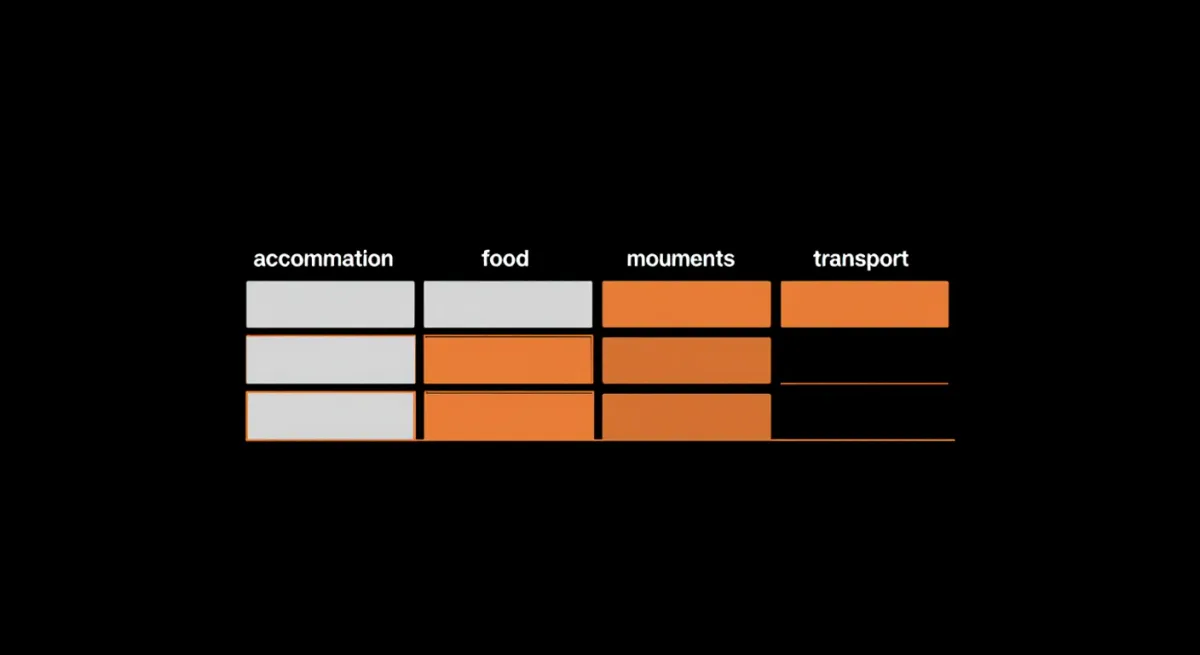
Budget a trip in three lines: fixed costs you pay once (flights, hotels, rail passes), a daily rate for everything variable (food, local transit, sights), and a 15 percent contingency on top. Run those numbers for a one-week domestic trip and a realistic per-person total lands around $1,500 to $2,500 — consistent with Bureau of Labor Statistics consumer spending data, which put average US household spending on transportation and lodging among the largest trip cost blocks as of the 2024 survey released in late 2025.
Why do most trip budgets fail?
Because they start with the daily spend and forget the fixed block. The two biggest costs of most trips — airfare and lodging — are booked once, before departure, and they set the floor of your budget regardless of how frugally you travel on the ground. A cheap daily rate cannot rescue an expensive flight-and-hotel core. The three-line method forces you to price that core first, while fares and rates are still low and cancellable, so the largest numbers are locked instead of estimated.
Line one: fixed costs
Price these in booking order. Flights first: use a price-tracking alert and book when the fare sits in the low range of its history, then hold that number. Lodging second: nightly rate times nights, plus taxes and fees, which routinely add 15 to 25 percent at US hotels and short-term rentals — always cost the total, not the headline rate. Then intercity moves: a second flight, a rail pass, a rental car with fuel and one-way drop fees. Everything on this line is a known number by the time you leave, and together it typically runs 60 to 70 percent of the total trip cost.
Line two: the daily rate
Set one number per person per day for food, local transport, entry fees, and small purchases, then sanity-check it against the destination's cost tier. As of early 2026, working planning tiers look roughly like this: high-cost cities such as Zurich, Tokyo's hotel districts, or New York at $100 to $175 per day mid-range; most of Western Europe, East Asia, and Australia at $60 to $120; much of Southeast Asia, Latin America, and Eastern Europe at $30 to $60. Adjust for your own habits — the day rate is a discipline tool, not a promise. Multiplying the rate by trip days gives line two.
Line three: contingency
Add 15 percent of lines one and two combined. This absorbs the fare increase on a rebooked flight, the taxi when the train stops running, the museum closed on Monday. Travelers who skip this line end up either abandoning activities mid-trip or putting surprises on a card at 20-plus percent interest. If the contingency comes home unspent, that is the first deposit toward the next trip — a far better outcome than borrowing mid-vacation.
Worked example: one week, one person
- Fixed: round-trip flight $420; seven hotel nights at $150 plus 18 percent tax, $1,237; no intercity moves — subtotal $1,657.
- Daily rate: $85 for six on-ground days, $510.
- Contingency: 15 percent of $2,167, about $325.
- Total: roughly $2,490 per person — right inside the range the method predicts.
Swap the destination tier or the flight fare and the same arithmetic holds; that is the point of a method rather than a guess.
When should you start saving, not just pricing?
As soon as the trip exists as an idea. Fixed costs come due in a lump — a flight and a hotel deposit can be two-thirds of the whole budget inside one week — so spreading that lump over the months before booking is the cheapest financing available. A practical cadence: open a separate savings pot the day you pick dates, feed it weekly with the estimated daily rate for the trip length, and let the fixed-cost purchases come out of it too. By departure day the pot should be near zero by design; anything left is the unspent contingency, and it rolls to the next trip rather than back into checking, where it tends to evaporate.
How to actually save against the budget
- Move dates, not standards: shifting a trip two weeks off-peak frequently cuts the fixed block by 20 to 40 percent — more than any on-ground thrift.
- Bundle deliberately: a flight-and-hotel package occasionally beats booking separately; compare the bundle total against your two fixed-line numbers before assuming.
- Track daily, not nightly: a 30-second note of the day's spend keeps line two honest; the trips that blow budgets do it quietly, a meal at a time.
- Cost the fees: bag fees, seat selection, car insurance, and city taxes are real money; if you count them in the fixed line at booking time, nothing later feels like a surprise.
Spend figures above reflect BLS Consumer Expenditure Survey data and published 2026 cost tiers, checked as of March 2026; verify current prices for your own dates before booking.