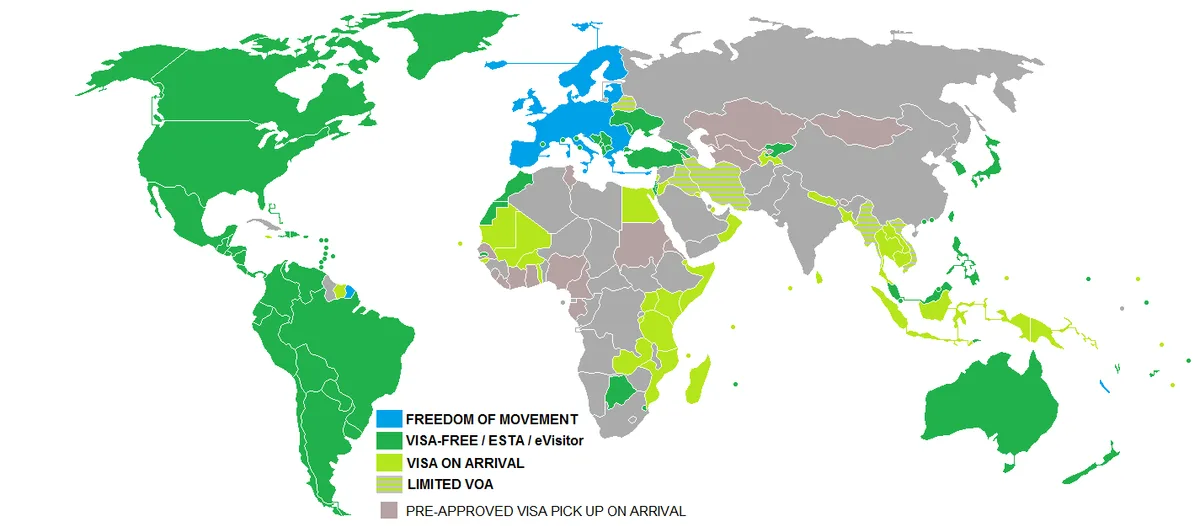
Some countries hand a US passport holder a free stamp at the border. Others want an online form and a fee before you fly. And a demanding few require a full application — documents, photos, sometimes an interview — approved in advance. There is no single list that stays true for long, because entry rules change with politics and reciprocity, often with little notice.
The practical answer is a habit, not a list: check the destination's official government or embassy source for your nationality before booking anything refundable. This explainer walks through the three tiers of tourist visas, what each one actually asks of you, and the mistakes that turn a booked trip into a canceled one. It is information, not immigration advice — for an individual case, the embassy is the only authority that counts.
What is a tourist visa, exactly?
A tourist visa is official permission to enter a country for leisure, granted by that country — not by your own. Tourism, as a category, is broader than a beach holiday: Wikipedia's overview of tourism notes that the UN's tourism definition covers people traveling outside their usual environment for leisure, business, and other purposes, for stays under a year. Visa categories split that spectrum up, and visiting on the wrong one — say, doing paid work on a tourist entry — is the classic way travelers get refused at the border or banned from returning.
Two dates matter on any visa, and they are not the same thing. The validity window is when you may enter. The duration of stay is how long you may remain once you do. Confusing them is how travelers overstay through no apparent fault of their own.
Which countries require no visa at all for US citizens?
A large share of the world's popular destinations admit American passport holders for short tourist stays with no visa at all — just a passport, sometimes a completed landing form, and occasionally a tourism fee paid at the airport or online. The qualifying conditions are where travelers trip: a minimum remaining passport validity (commonly six months), proof of onward travel, and a hard cap on days, after which the clock and the penalties start.
Our guide to visa validity versus duration of stay covers those two dates in detail. The standing caveat applies to every entry rule in this piece: rules change, so verify with the official government source before you book.
How do e-visas work, and why do travelers prefer them?
An e-visa moves the application online. You fill in a form on the country's official portal, upload a photo and passport scan, pay a fee, and receive an approval by email — usually a PDF to print or a record linked to your passport number. You still queue at immigration on arrival; the e-visa is the pre-clearance, not the stamp.
The convenience is real, but so is the scam surface. Look-alite sites charge multiples of the official fee for what is a free or cheap government form. The defense is dull and effective: find the portal through the country's official government or embassy site, not through a search ad. We compare the failure modes of each option in Visa on Arrival vs E-Visa: Which Is Safer for Your Trip, and When Each One Fails. This connects to our earlier piece, Visa on Arrival vs E-Visa: Which Is Safer for Your Trip, and When Each One Fails.
What this means for planning: apply for e-visas early enough to fix a rejected photo or a typo in your passport number. Application photo and form errors are among the most common reasons approvals stall, a problem we detail in The Photo and Form Mistakes That Get Visa Applications Rejected. Readers following this should also see The Photo and Form Mistakes That Get Visa Applications Rejected Before Anyone Reads Them.
What is a visa on arrival, and when does it fail?
A visa on arrival is granted at the border — you arrive, pay the fee, and receive the entry stamp in the same transaction. It sounds effortless, and often it is. The failure cases are predictable: the fee is cash-only in local currency and you have none; the queue is hours long after a long-haul flight; or the officer asks for proof of onward travel and your one-way ticket answers the question badly.
Visa on arrival is also the tier most subject to change. Countries tighten or waive it with little warning, and airlines enforce whatever the current rule is at the gate — not the rule you read on a forum last spring. If your itinerary depends on a visa on arrival, confirm it with the destination's official immigration authority within a few weeks of departure, and carry the fee in the accepted form.
Which countries require a full advance visa for Americans?
The third tier is the traditional consular visa: an application submitted to an embassy, consulate, or authorized visa center before travel, with supporting documents, fees, and sometimes an in-person appointment. Processing runs from days to many weeks depending on the country and the season, which is why the advance-visa tier sets your planning timeline rather than following it.
The most consequential example for American travelers is the Schengen area of Europe, where visa-required nationalities follow a shared application process; our walkthrough of how the Schengen visa application really works covers which consulate and which deadline. US citizens themselves currently travel to most of Europe visa-free for short stays, but the region's upcoming electronic authorization will change the paperwork — we track that in our explainer on how the Visa Waiver Program and ESTA work, the American mirror-image of the same idea.
One more trap hides in the flight path, not the destination. Some countries require a transit visa even when you never leave the airport. Check connections before you book, not after: our guide to whether you need a transit visa for a connecting flight shows how to tell.
How should you actually check the rule for your trip?
- Start with the destination's official immigration portal or its embassy in the US — never a forum, a blog, or a reseller's summary.
- Check your passport's remaining validity against the destination's stated minimum, and renew early if it falls short.
- Confirm whether the rule differs by entry point — some land borders and airports run different procedures.
- For any visa-required country, note the processing time and work backward from your departure date, not forward from your booking.
- Save the official confirmation — PDF, email, receipt — offline, in case the border officer asks and the airport Wi-Fi does not cooperate.
Our broader Visas section keeps the country-level explainers current as rules shift, and our Planning hub covers the documents-and-timing side of a trip from the first search to the return flight.
What this means for your next trip
The evidence supports a simple hierarchy: no visa, e-visa, visa on arrival, advance visa — in roughly that order of convenience, and roughly the reverse order of certainty. The less certainty a tier offers, the more the verification habit matters. Check the official source before booking, again before departure, and treat any third-party site charging a premium for a government form with suspicion. That is the whole discipline. It takes ten minutes, and it is the difference between a smooth arrival and a very expensive conversation at the gate.