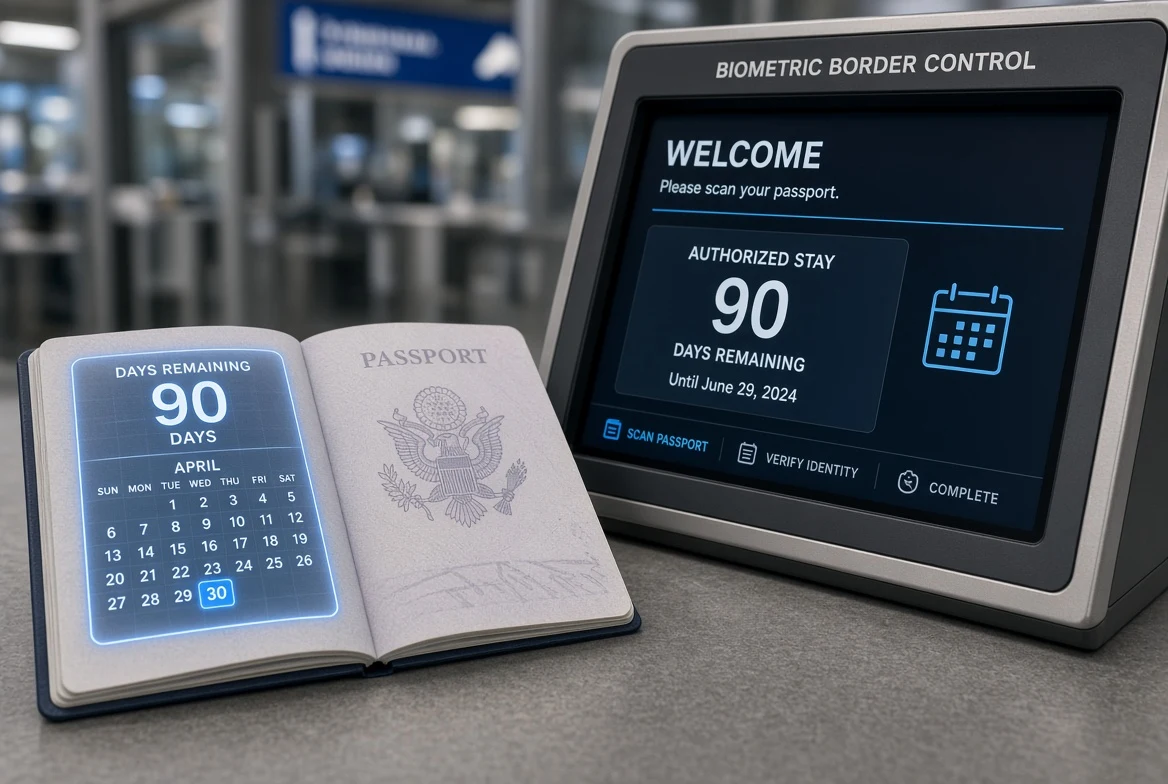
The rule is one number pair, not twenty-nine national quotas: US citizens may stay up to 90 days within any 180-day period in the entire Schengen area combined, counted as a rolling window that slides with each day, per the Schengen Borders Code as applied to visa-free travelers as of 2026. Enter on May 1 and stay 90 days, and you cannot re-enter visa-free until the earliest of those days falls out of the backward-looking window — which is how travelers with weeks of legal time remaining on paper still get refused at the gate. The clock is arithmetic; the refusals happen when people feel it instead of counting it.
This is information, not immigration advice; border officers make the final call on any entry.
How is the 180-day window calculated?
Backward, always. On any given day, count 180 days back from that day, add up every day you spent inside Schengen within that span — including the arrival and departure days themselves — and the total must be 90 or fewer. The window moves forward one day at a time, releasing the oldest day as each new day arrives. That rolling mechanic is what surprises long-planners: a January trip does not reset a calendar-year allowance, it simply occupies days that take 180 days to fall out of the window. The European Commission publishes an online days-remaining calculator for exactly this arithmetic, and the entry-exit stamps — now electronically recorded at external border crossings under the Entry/Exit System phased in from late 2025 — make the data authoritative rather than memory-based.
Does time in one Schengen country use the same allowance as another?
Yes — that is the single most expensive misunderstanding in European trip planning. The 90 days cover the whole zone: a fortnight in Portugal, a week in Austria, and three days in Greece consume 24 days of one shared allowance. Schengen includes most EU states plus Iceland, Norway, Switzerland, and Liechtenstein; Bulgaria and Romania apply the rule as full members since their 2025 accession to checks at all borders. Ireland and Cyprus sit outside it — Ireland manages its own arrangement, Cyprus its own — and non-Schengen EU-adjacent stops such as the United Kingdom use separate allowances entirely. A European itinerary therefore has two clocks: the Schengen 90/180, and whatever each outside country grants, typically six months for US visitors to the UK.
Do days in Croatia or Cyprus count?
Croatia is inside: full Schengen since January 2023, its days count against the 90. Cyprus is outside the zone, with its own entry rules, so its days do not consume Schengen time. The Caribbean-style trap is geography: countries that look separate, like Portugal and Spain or France and Belgium, are one allowance, while countries that look adjacent, like Greece and Cyprus or Ireland and Northern Ireland, split into different systems. Check membership before assuming — the composition has changed twice since 2020, and it is the composition, not the map, that sets the rules.
How do the Nordic and microstate quirks work?
A few geographies reward attention. Iceland, Norway, Switzerland, and Liechtenstein are inside the zone without EU membership, so a Swiss base spends the same 90-day allowance as a French one. Monaco, San Marino, Vatican City, and Andorra have no separate border control — entering them means entering, or remaining inside, Schengen for allowance purposes, even though their names appear on no visa list. Greenland and the Faroe Islands sit outside the zone despite Danish statehood and need separate arrangements. The Azores, Madeira, and the Canaries are inside, despite sitting far into the Atlantic. None of these exceptions changes the arithmetic of the rule; they change which places the rule silently applies to.
What happens on an overstay?
Overstays are recorded at exit and travel with the passport. Consequences escalate with length and repetition: fines, deportation orders, entry bans — commonly one to three years for significant overstays under Schengen rules — and, most damaging for genuine travelers, skepticism at future borders even when the letter of the law allows entry. Marginal cases have a better tool than gambling: an extension application in country, filed with the host state's immigration authority before the 90 days run out, granted for documented reasons such as illness. Border refusal for insufficient remaining allowance, though, is routine and unappealable at the desk — the calculator exists so no one needs to negotiate.
How do you plan long European trips within the rule?
- Split the summer: 90 days inside Schengen, then a base outside — the UK, Ireland, Cyprus, Turkey, or the Balkans — while days fall out of the window.
- Count backward before booking, using the official calculator with real dates.
- Remember day one and the exit day both count; a three-week trip is 21 days, not 19.
- Check membership for every stop on multi-country routes; the zone has grown since 2020.
The 90/180 mechanics, membership list, and consequences above checked as of July 2026 against the Schengen Borders Code and US State Department guidance; verify current zone composition and any national quirks before booking long stays.