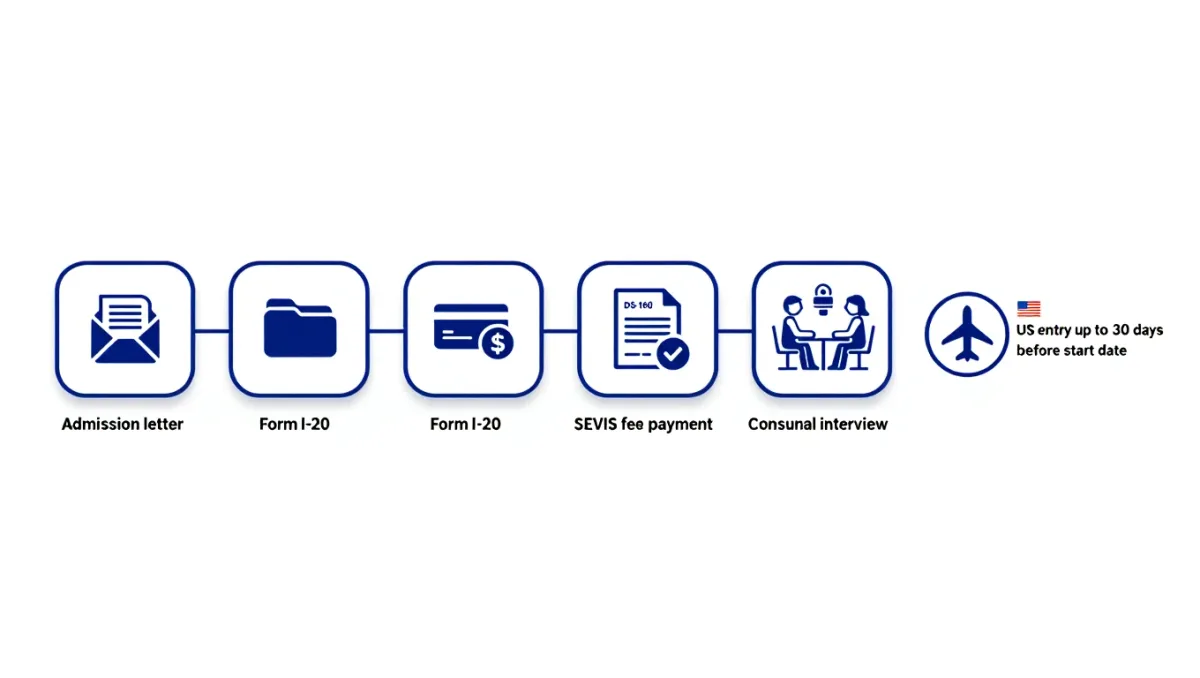
The F-1 is the US student visa for full-time academic study, and its mechanics come down to three documents in a fixed order: an I-20 issued by your SEVP-certified school, a SEVIS I-901 fee of $350 paid against that I-20, and a DS-160 visa application with an interview at a US embassy or consulate — the MRV application fee is $185 (fees as of 2025). You cannot pay SEVIS or book the interview before the school issues the I-20, so the school's processing speed sets your whole timeline.
This is information, not legal or immigration advice, and student visa rules change — verify fees and procedures at travel.state.gov and with your school's international-student office before you act.
What comes first, the I-20 or the visa application?
The I-20 always comes first. After admission, the school's designated school official (DSO) enters your details in SEVIS, the federal database behind the F-1 system, and issues Form I-20. That form carries your SEVIS number starting with N, your program start date, and your estimated costs. Only then can you pay the $350 I-901 fee at FMJfee.com and complete the DS-160. Consulates require all three references — I-20, SEVIS receipt, DS-160 confirmation — at the interview.
How long does each step take?
- I-20: days to a few weeks after you prove funding. Schools ask for bank statements or sponsorship letters covering at least the first year's costs shown on the I-20.
- SEVIS I-901 fee: instant online payment; the receipt prints immediately. Pay at least three business days before the interview.
- DS-160 and interview booking: appointment waits vary sharply by post and season — May through August is peak for fall enrollment, so book the moment you have the I-20.
- Visa issuance: many applicants receive the passport back within days of approval, but administrative processing under INA 221(g) can add weeks and has no fixed ceiling.
New students may enter the US up to 30 days before the program start date printed on the I-20 — arriving earlier on an F-1 visa is not permitted, and a B-1/B-2 arrival cannot be converted to F-1 status without leaving or filing a change of status.
What is "duration of status" and why does it matter?
Your F-1 visa stamp and your F-1 status are different things. The visa stamp — the sticker in the passport — is only for entry and can expire while you study. Your status runs D/S, "duration of status": the program length on the I-20, plus any authorized practical training, plus a 60-day grace period. You can stay legally as long as you remain enrolled full-time and your I-20 stays valid, which is why a dropped course load or a delayed graduation requires the DSO's sign-off before, not after, the change.
What can F-1 students do for money?
- On-campus work: up to 20 hours per week during the academic term, full-time during breaks, no separate authorization needed.
- CPT (curricular practical training): off-campus work that is an integral part of the curriculum, authorized by the DSO before it starts.
- OPT: 12 months of post-completion work authorization per degree level, applied for through USCIS with a filing fee and an estimated processing time measured in months — file up to 90 days before program completion.
- STEM OPT: a 24-month extension for approved STEM degrees, requiring an E-Verify employer and a formal training plan (Form I-983).
Unauthorized work is the fastest way to lose status permanently — even a single off-campus paycheck without authorization is generally unrecoverable.
What do consular officers actually ask?
The interview centers on three questions: Are you a genuine student? Can you pay without working illegally? Will you return home after the program? Strong answers are specific — name your program, your funding source with amounts, and your post-study plan tied to home-country opportunities. Vague funding or a sponsor with no documented relationship to you is a common refusal ground. A refusal under INA 214(b) can be overcome in a new application with materially better evidence, but the fee is paid each time.
What about family and visa-stamp renewals?
Spouses and children come on F-2 visas; the school issues each dependent a separate I-20 and the funding proof must rise accordingly, typically several thousand dollars per dependent per year per each school's published cost sheet. F-2 spouses may not work and may not study full-time; F-2 children may attend school. Separately, the visa stamp in your passport can expire while you remain legal in D/S status. A valid stamp is required only when you re-enter after travel, so students who stay through the program often never renew it. If you do plan trips home, a stamp renewal means a new interview, a new $185 fee, and an I-20 endorsed for travel by your DSO within the last 12 months.
Every fee and rule above was checked against State Department and ICE guidance as of 2025; both agencies update pages without much notice, so confirm the current figures the week you apply.