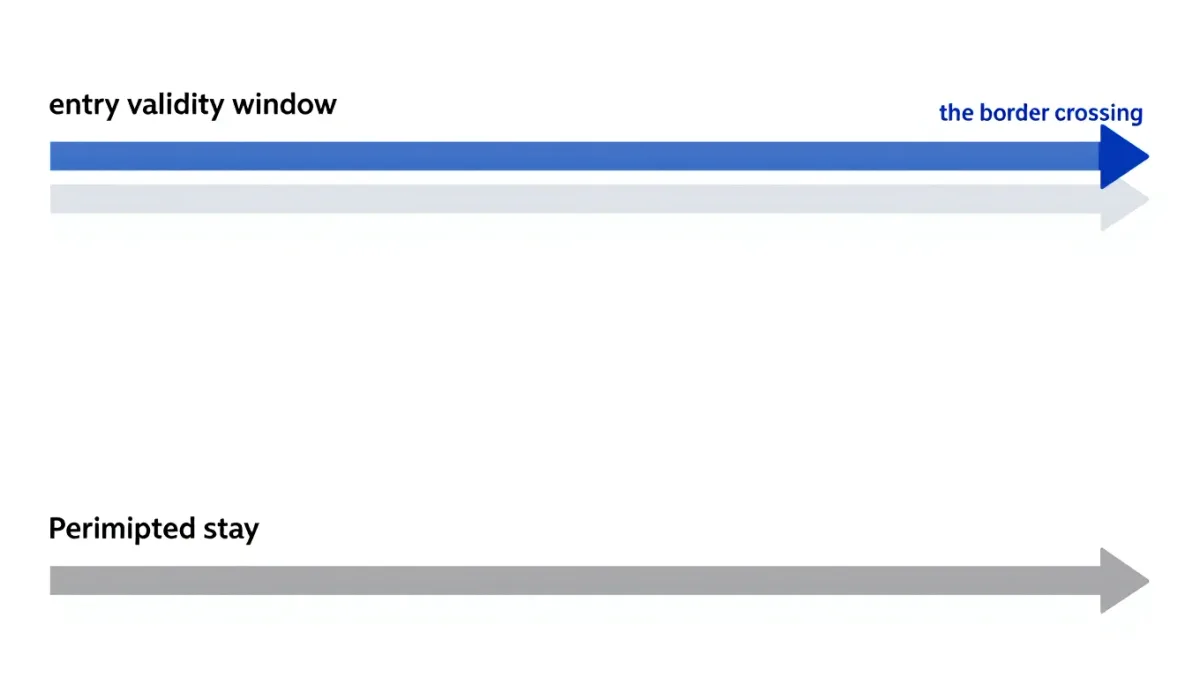
Visa validity and duration of stay are two different clocks: validity is the window during which you may cross the border, while duration of stay is how long each crossing lets you remain — and the entry stamp or electronic admission record, not the visa sticker, is what legally fixes your deadline to leave. Travelers who plan by the visa sticker alone overstay without noticing, because in countries like the United States the electronic I-94 admission record — checkable online by passport number — controls, and it can be shorter than the visa's validity.
This is information, not legal or immigration advice. Admission practice varies by country and port — verify your own admission record after every entry and confirm rules with the issuing authority.
How do the two clocks work in practice?
Take a visa issued in July 2026 valid for five years with 180-day stays. On the visa's last valid day you may still cross the border — and in many systems you are then admitted for the full permitted duration, legitimately remaining well past the sticker's expiry. Reverse case: a ten-year US visitor visa admits you for a period set at the border, commonly six months for B2, printed nowhere on the visa. The sticker answers "when can I enter and how many times"; the admission record answers "when must I leave." Planning flights by the sticker is the category error; planning by the admission record is the fix.
What is a reciprocity schedule and why does it change your validity?
The US, and several other issuers, set visa validity by nationality rather than by applicant merit: the State Department's reciprocity tables map each country's passport to the validity and fee the US grants in return for what the US citizens receive there. That is why one nationality receives a 10-year multiple-entry B1/B2 while another receives three months, single entry — same visa class, different reciprocal terms. The schedule is the first thing to check when comparing notes with a friend whose "same visa" lasted five times longer than yours.
What happens if you overstay?
| Overstay (US, nonimmigrant) | Consequence |
|---|---|
| Any overstay | Visa automatically voided; future applications must disclose it |
| Over 180 days | 3-year reentry bar on departure |
| Over 1 year | 10-year reentry bar on departure |
Other systems differ in severity but share the pattern: fines scaled to days (common in Gulf and Asian states), exit bans until paid, and refusal records that follow you to allied countries' applications. An overstay of even one day can also strip tax treaties, insurance coverage, and onward-visa eligibility that assume lawful status.
Can you extend a stay instead of overstaying?
Often, yes — before the deadline, never after. The mechanics repeat across systems: file the extension with the immigration authority while your current admission is still valid, show funds and a reason, pay the fee, and keep the receipt as proof of pending status; in the US, a timely-filed USCIS extension application generally tolls unlawful-presence accrual while pending. Two rules protect everyone: extensions are measured from the admission record's date, not the visa's, and approving authority rests with the immigration service of the destination — a hotel, agency, or employer cannot extend an admission, whatever they promise.
How do other major systems fix the leave-by date?
Schengen marks the permitted stay on the entry stamp or in the residence-permit record; under the uniform visa, the arithmetic is 90 days within any rolling 180-day window, calculated backward from each day present — overstays surface months later in border systems even when each trip looked short. The UK writes a leave-until date on the decision letter or entry stamp, and breaching it lands on a digital immigration record that gates future applications. Gulf states tie duration to the sponsor or hotel registration, so an amendment to your booking can silently change your permitted stay. Japan, unusually, stamps the permitted period at entry on landing permission, independent of the visa. The common thread: every system has a document other than the visa that fixes the deadline — find it, save it, calendar it.
What should you do the day you arrive?
- Find the admission record: entry stamp with a written-until date, an electronic I-94 lookup in the US, or a stamped permit card elsewhere.
- Read the date and photograph the stamp or record — electronic systems fail, and a screenshot has settled disputes.
- Put the deadline in your calendar with a 30-day warning, because extension processing times run in weeks.
- Confirm the permitted activities match your plans — the wrong activity on the right visa is still a status violation. The wrong activity on the right visa is a status violation all the same, and the next entry officer reads your history with that in mind.
Rules checked against State Department reciprocity tables and immigration-authority guidance as of mid-2026; admission practice is officer- and port-specific — verify your own record at every entry.